

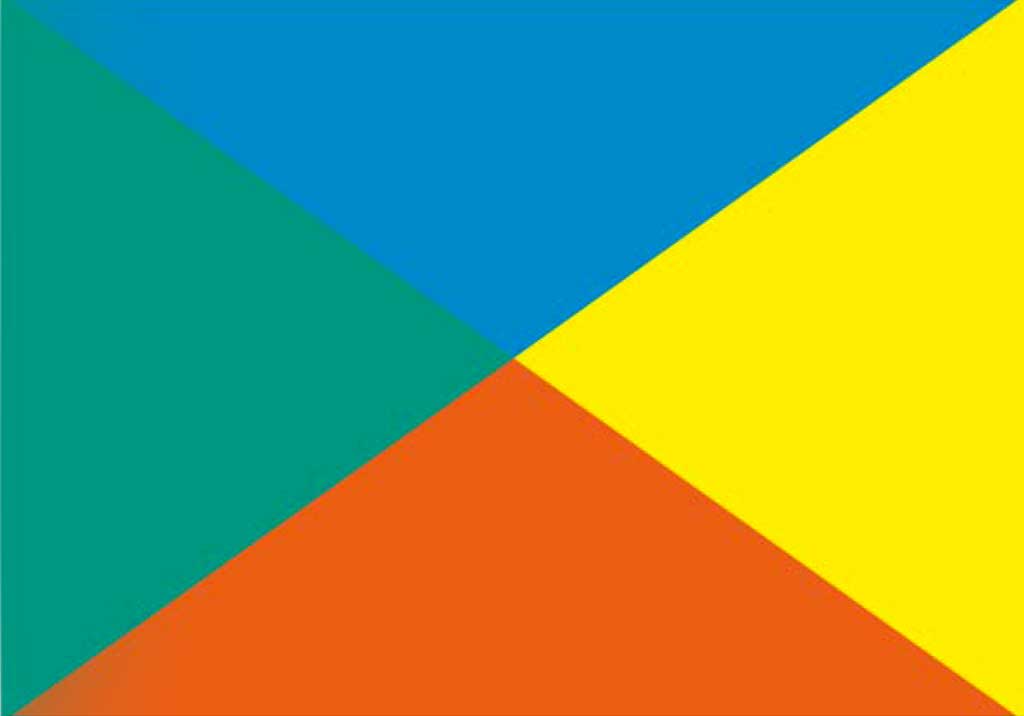
Ever since it opened, the MRAC has intrigued us with its colorful facade, with its pared-down yet effective graphics: white lines, geometric shapes in primary colors, the whole forming a perfect harmony… Located not far from the Asensò studio, we’ve pushed open the door time and time again to this atypical place, totally integrated into a village that wasn’t promised to become a place dedicated to art and culture. Here, we take a look at the work carried out in situ by Daniel Buren, the artist who dressed this now emblematic site in the town of Sérignan.
In 1965, Daniel Buren perfected his visual tool: alternating 8.7 cm-wide vertical stripes in white and color, repeating his stripes ad infinitum and on all surfaces. The choice of an industrially-produced motif reflects his desire for objectivity. In 1966, Daniel Buren joined forces with painters Olivier Mosset, Michel Parmentier and Niele Toroni, with whom he organized highly controversial events, creating the BMPT group. What binds BMPT together is the common practice of systematically repeating the same motif, and the desire to radically oppose the highly academic Parisian art scene. This work is an opportunity to examine not only the physical limits of painting, but also the political and social boundaries of the art world. Always posing as a theorist of his own work, Buren accompanies all his installations with a description, with explanatory notes: from the use in his first canvases of an industrial fabric made up of equal, vertical white strips, to the use of this fabric as a place for inscribing painting, to painting as a non-place.
Buren quickly developed the concept of in situ work, i.e. an artistic intervention intrinsically linked to the place in which the work is programmed and carried out. He always analyzes the site, revealing its most significant and least visible features. Buren himself speaks of an instrument for seeing, because paradoxically, by limiting himself to a single motif, he achieves a broadening of the viewer’s visual field. The work reveals the place, and this very place makes it untransportable and therefore ephemeral.
At the heart of the RMCA, Daniel Buren presents an in situ installation that maintains a dialogue with the architecture of the site. The artist takes advantage of transparency to propose a play of colors and shapes, set in motion in the space by natural light. Each hour of the day, the public discovers a new installation. The explosion of color creates a veritable mise en abyme of space. The impression that the work is bursting at the seams, accentuated by projections on the walls and floor, encourages the viewer to move his or her whole body, not just his or her gaze.
The RMCA is open Tuesday to Friday from 10:00 to 18:00 and at weekends from 13:00 to 18:00.
Closed on Mondays and public holidays.
Open all year round.
Musée régional d’art contemporain
Languedoc-Roussillon
146 avenue de la Plage, Sérignan
Source: MRAC